Why Your Cache Count Drops in Late August Even When You Go Out More
Quick Answer: Late August is the hardest finding month of the year, and three things stack up to cause it. Vegetation is at maximum volume - the same hide that was visible in April is now behind two feet of growth that will not be there in October. Heat pushes searches into midday, when the light is flat and overhead and shadows that reveal container edges disappear. And foot traffic peaks, so you are doing shorter, more self-conscious searches at exactly the moment they need to be longer. None of this is skill regression, and all three fix themselves within about six weeks.
You have been out three times this week. Two DNFs and a find that took forty minutes on a cache rated one and a half stars.
The instinct is to assume the cache is gone. Sometimes it is. But late August has a specific and predictable set of conditions that make finding harder, and if you know which one is working against you on a given day, you can usually work around it.

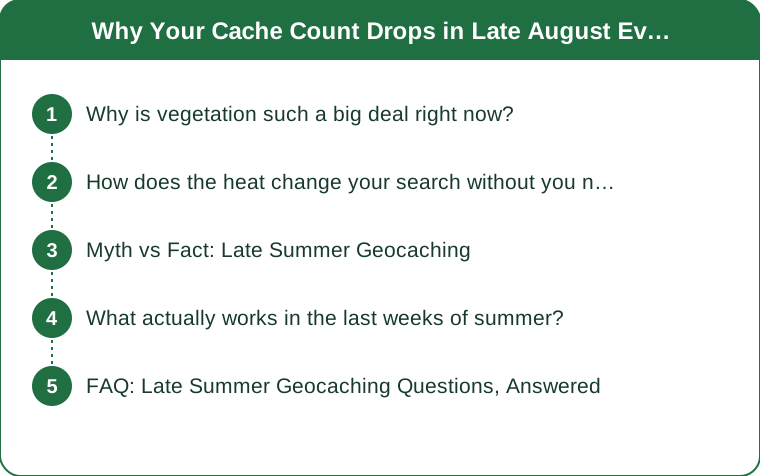
Why is vegetation such a big deal right now?
Because you are searching at the annual peak of plant volume, and the hide was almost certainly placed at a different point in the cycle.
Most caches are placed in spring or early summer. The cache owner walked to the spot, saw a clear line of sight to the container, and set a difficulty rating based on what they could see. By late August that same location has months of accumulated growth on it - and in a wet summer, dramatically more.
This is why difficulty ratings feel wrong in August specifically. A two-star hide placed in May is genuinely a three-star hide in late August and back to a two in November.
The practical adjustment is to search by feel more than by sight in dense cover. Run a hand along the underside of rails, in tree hollows, behind sign posts - the places a container physically can be - rather than scanning visually for something that vegetation has swallowed.
Also read the logs by date, not just by count. A cache with steady finds in April and May and three DNFs since July is far more likely to be findable-but-overgrown than actually missing. The pattern of when the DNFs started tells you which problem you have.
How does the heat change your search without you noticing?
It shortens every search, and it moves you to the worst light of the day.
The average search that ends in a find takes longer than most cachers think - and heat quietly cuts it short. There is a well-documented pattern where searchers in uncomfortable conditions abandon a search several minutes earlier than they would in mild weather, and those minutes are exactly where the difficult finds live.
Heat also pushes people out of the early and late hours into whatever time is convenient, and midday sun is genuinely worse for searching. Low-angle morning and evening light rakes across surfaces and casts shadows that reveal edges, seams and unnatural straight lines. Overhead midday sun flattens everything and washes out exactly those cues.
And the third heat effect is on the hardware. Phone GPS accuracy degrades when the device is hot - thermal throttling reduces processing, and a phone that has been in direct sun in a car reports coordinates with noticeably more drift. If your arrow is dancing over a fifteen-foot circle, check whether your phone is uncomfortably warm to hold before blaming satellite geometry.
Go out at 7am. The difference is not subtle.

Myth vs Fact: Late Summer Geocaching
Myth: A cache with recent DNFs is probably gone. Fact: In August, DNF clusters correlate much more strongly with vegetation than with missing containers. The tell is seasonal - if the same cache had a DNF cluster last August and then finds again in October, it is an overgrowth cache, not a missing one.
Myth: Better GPS accuracy would solve it. Fact: Under full summer canopy, no consumer device gets you closer than about fifteen to thirty feet reliably, because leaves attenuate and scatter the signal. The dense canopy is the accuracy problem, and it is another thing that resolves itself in October. Learn to work the circle rather than chase the arrow.
Myth: Bug spray does not affect anything but comfort. Fact: DEET is a plasticizer. It degrades plastic containers, dissolves printed log sheets, and clouds acrylic - and it transfers off your hands onto everything you touch. Apply it, then wipe your hands before handling any container.
Myth: Muggles are only a problem in urban caches. Fact: Late August trailheads and parks are at peak use, and rural caches see their highest foot traffic of the year. The self-consciousness effect is strongest where you least expect an audience.
What actually works in the last weeks of summer?
Change when you go, and change what you target.
Go at first light. Cooler, better light angle, dramatically fewer people, and a cool phone. This single change fixes three of the four problems at once and costs nothing.
Shift toward hide types that vegetation does not affect. Urban micros, guardrail hides, lamp post skirts, parking lot and building-adjacent caches are all in the same condition in August as in April. Save the wooded multi-caches for October when the leaves come down and the same hides become genuinely easier.
Use satellite imagery date-checked to winter. Most mapping tools let you view older imagery. A leaf-off winter satellite view of the same coordinates shows you structures, paths and features that summer canopy is currently hiding.
Read the hint before the search, not after twenty minutes. There is a purist habit of saving the hint, and in August it costs finds. The hint was written by someone standing there in a different season.
Carry a small mirror and a light. Both are more useful in dense growth than any app - a light under a ledge in bright daylight reveals shapes that eyes adjusted to full sun cannot resolve.
FAQ: Late Summer Geocaching Questions, Answered
Should I log a DNF if I think it is just overgrown?
Yes, and say so in the log. A DNF that reads unable to reach GZ due to heavy vegetation is genuinely useful to the owner and to the next searcher, and it is a completely different signal from a bare DNF. Owners use log text to decide whether a maintenance trip is needed, and vague DNFs cause unnecessary trips.
Is it worth caching in the rain in late summer?
Surprisingly, yes. Rain clears the trails of casual foot traffic, cools everything down, and wet ground shows recent disturbance. The main cautions are wet plastic being slippery to grip and log sheets being ruined by wet hands - dry your hands before opening anything.
Why does my phone say I am at zero when I am clearly not?
Under summer canopy, the phone is choosing between reflected and attenuated signals and can settle on a confident-looking wrong answer. Walk twenty feet away in four directions and approach again from each. Where the arrow points from four different approaches tells you far more than standing at the spot watching it drift.
TL;DR:
- Late August is peak vegetation volume, and most hides were placed and rated in a much clearer season.
- Heat shortens searches and pushes them into flat midday light - the worst light for spotting container edges.
- A hot phone reports worse coordinates. Check the device temperature before blaming the satellites.
- Read DNF logs by date pattern, not by count - a seasonal cluster means overgrown, not missing.
- Go at first light, target urban and hardscape hides now, and save wooded caches for October.
- Wipe DEET off your hands before touching any container.
Your find rate is not falling. The difficulty rating on everything in the woods quietly went up a star, and it comes back down when the leaves do.
Keep Reading
This article is for general informational and styling purposes only. Fit, sizing, and product availability may vary.