Why Your Cache Keeps Getting Muggled and How to Fix the Hide
Quick Answer: Repeat muggling is a design problem, not bad luck. The three causes that account for most of it are a container that looks interesting to a non-cacher, a hide that forces searchers to be visibly conspicuous, and a location with a sightline from somewhere people linger. Fix it by making the container boring, moving the hide so the retrieval posture looks normal, and checking the sightlines at the time of day when the area is busiest - not at 7am on a Sunday when you do maintenance.
If you have replaced the same container three times, the temptation is to blame the area and archive it. Before you do, it is worth being honest that the hide is probably telling people it is there.

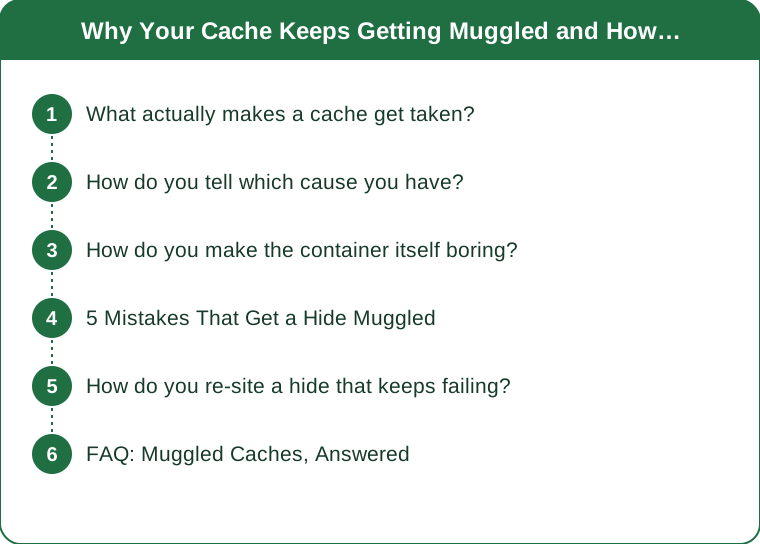
What actually makes a cache get taken?
Visibility to someone who is not looking for it. Almost every muggled cache was seen by accident first. A container that catches the eye - shiny, coloured, oddly placed, or obviously man-made in a natural setting - gets investigated.
Watched retrievals. The second largest cause, and the one hiders control least directly. If finding your cache requires someone to reach behind a sign for 40 seconds while facing a bus stop, somebody eventually watches them do it and goes to look afterwards.
Groundskeeping and maintenance. A huge share of what gets logged as muggled was actually removed by a park crew, a hedge trimmer, or a contractor clearing a fence line. This is not theft and it is entirely predictable from the location.
Weather and animals. Containers get washed out of drainage areas, dragged off by animals, and buried by leaf fall or landscaping mulch. Also not theft, and also predictable.
Curiosity in high-footfall areas. A container in a busy urban spot has hundreds of pairs of eyes on it a day. The same container in a hedgerow has five.
And occasionally, genuine hostility. Rare, but it exists in places where a previous cache caused a complaint. If a hide keeps vanishing within days of every replacement, this is worth considering.
How do you tell which cause you have?
Read the pattern in the timing. A cache that disappears within a week of every replacement is being seen or targeted. One that lasts four months and then goes is more likely to be maintenance or weather.
Check whether it goes at the same time of year. Vanishing every spring and autumn strongly suggests grounds maintenance, hedge cutting, or leaf clearance rather than muggles.
Look at the DNF logs before the disappearance. A run of did-not-find logs followed by a find often means it moved rather than went, and it is probably a metre away under leaf litter.
Look at the logs of the last few finders. If several mention being watched, having to wait for people to pass, or feeling conspicuous, you have a sightline problem and the container was almost certainly seen during a retrieval.
Go and stand at the site at the busiest hour. This is the single most useful diagnostic and almost nobody does it. Most maintenance happens early on a weekend morning when the area is empty and the hide looks perfect. Go back at 5pm on a weekday and the same spot may be overlooked by twenty people.
Check what is above and behind you. Windows, balconies, a cafe terrace, a security camera, a bench. Sightlines from above are the ones hiders miss most consistently.
How do you make the container itself boring?
Match the material and colour to the immediate surroundings, not to nature in general. Brown in a green hedge is more visible than green. Grey is right against stone and wrong against bark.
Avoid anything reflective. A metal lid, a clear lid, or fresh tape catches light and draws the eye from ten metres. Matt finishes disappear.
Camouflage tape works, and it works best when it is dirty. New camo tape has a sheen and a pattern that reads as artificial. Rubbing it with soil at the site fixes this in ten seconds.
Bigger containers get taken more. An ammo can in a public park is a find; a 35mm film pot is invisible. If the location is exposed, size down even though it costs you swag capacity.
Label it clearly as a geocache on the outside. This feels counterintuitive and it reduces losses. Many removals happen because someone finds an unmarked container and treats it as litter or, worse, as something suspicious. A visible official sticker and a short note turns a mystery object into an obvious game piece.
Do not use anything that reads as a hazard. Anything resembling a pipe, a device, or a sealed metal cylinder in an urban setting will be reported, and rightly so. That is not a muggling problem, it is a serious problem.
And weight it or tether it if water or animals are the issue. A container that floats out of a culvert is not being stolen.

5 Mistakes That Get a Hide Muggled
1. Choosing the spot for the searcher instead of for the search. A hide that is delightful to find is worthless if retrieving it looks bizarre. Ask what the finder’s body will be doing for the 30 seconds they are at the site, and whether that looks normal to a passer-by.
2. Hiding it too close to a bench, bus stop, or smoking area. Anywhere people wait is a place people watch. Ten metres of extra distance from a lingering spot is worth more than any amount of camouflage.
3. Making it too hard, so people search too long. Counterintuitively, an over-difficult hide gets muggled more, because searchers spend five minutes visibly rummaging instead of thirty seconds. Better hints reduce muggling.
4. Placing it where a strimmer goes. The base of a fence post, the edge of a mown path, and the foot of a hedge are exactly where maintenance equipment passes twice a year. This is the third mistake that surprises experienced hiders - they blame muggles for what a groundskeeper did.
5. Never updating the hint after the third replacement. If people keep struggling, the hint is not doing its job, and every extra minute of searching is extra exposure.
A sixth, briefly: replacing the container in exactly the same place each time. If a spot has been compromised, it stays compromised - somebody knows where to look now.
How do you re-site a hide that keeps failing?
Move it at least ten to fifteen metres, not one. A small adjustment keeps every original sightline. Moving it out of view of the lingering spot is the point.
Update the coordinates properly and post a note. Nothing generates DNFs and frustration like a moved cache with old coordinates, and a run of DNFs makes the next real disappearance harder to spot.
Change the hide type as well as the position. If a magnetic hide keeps going, a container wedged in a natural cavity is a genuinely different proposition and will not be found by anyone who has learned to look for magnets there.
Aim for a retrieval that looks like a normal human action. Tying a shoelace, leaning on a wall, adjusting a bag on a fence rail. If retrieval looks like something people do anyway, watchers do not register it.
Consider the seasonal change you are about to walk into. A hide chosen in high summer sits behind full foliage. In six weeks that foliage will be gone, and a spot invisible in August is fully exposed in November. This is the most common reason autumn brings a wave of muggling, and it is entirely predictable in September.
And be willing to archive. Some locations are genuinely unworkable - constant footfall, active maintenance, or a landowner who does not want it there. Three replacements in a year is a reasonable point to stop spending money and put the hide somewhere better. A well-placed cache elsewhere serves the community more than a heroically maintained one that is never there when people arrive.
FAQ: Muggled Caches, Answered
How many replacements is too many?
There is no rule, but three in twelve months is a strong signal that the hide is the problem rather than the luck. At that point either redesign it substantially or move it somewhere else entirely.
Should I tell finders the cache has been muggled repeatedly?
Yes, in the description. It sets expectations, and it prompts finders to be more discreet and to log more usefully. Finders who know a cache is fragile are noticeably more careful with it.
Does a bigger, better-hidden container help?
Better-hidden helps, bigger usually does not. Size is the main driver of accidental discovery in exposed places. In an isolated woodland the calculation reverses and a larger container is fine.
Is it worth adding a note asking people not to take it?
Yes. A clear geocache label with a short explanation and a contact route prevents a meaningful share of removals, especially the ones where someone was tidying up rather than taking a prize.
What about a camera or a tracker?
Do not. Filming a public place to protect a container creates a far bigger problem than the one it solves, and trackers in hidden containers attract exactly the kind of attention you are trying to avoid.
TL;DR:
- Repeat muggling is a design fault: an interesting-looking container, a conspicuous retrieval posture, or a sightline from where people linger.
- Diagnose by the pattern - weekly losses mean it is being seen, seasonal losses usually mean grounds maintenance rather than theft.
- Make the container boring, matt, small in exposed places, and clearly labelled as a geocache so tidiers do not bin it.
- Better hints reduce muggling, because searchers spend less time visibly rummaging.
- Re-site by ten to fifteen metres and change the hide type; three replacements in a year is a fair point to archive and place it somewhere better.
And check your hide again in six weeks. The foliage that hides it today will not be there in November, and autumn exposure is the most predictable muggling wave of the year.
Keep Reading
This article is for general informational and styling purposes only. Fit, sizing, and product availability may vary.