Why Autumn Caches Are Easier to Find and Harder to Reach
Quick Answer: Leaf fall makes caches visually easier — sight lines open, hides that were screened all summer become obvious, and cover is gone. It simultaneously makes them physically harder to reach: leaf litter hides trip hazards and the cache itself, ground gets slippery, GPS accuracy improves under bare canopy but paths get muddier, and daylight disappears an hour earlier than you planned for.
Two things happen in the same fortnight and they pull in opposite directions.
The cache you failed to find twice in August will take you four minutes in October. Getting to it will take twenty minutes longer, and getting back will be in the dark if you are not careful.
Here is what actually changes, and how to plan around both halves.
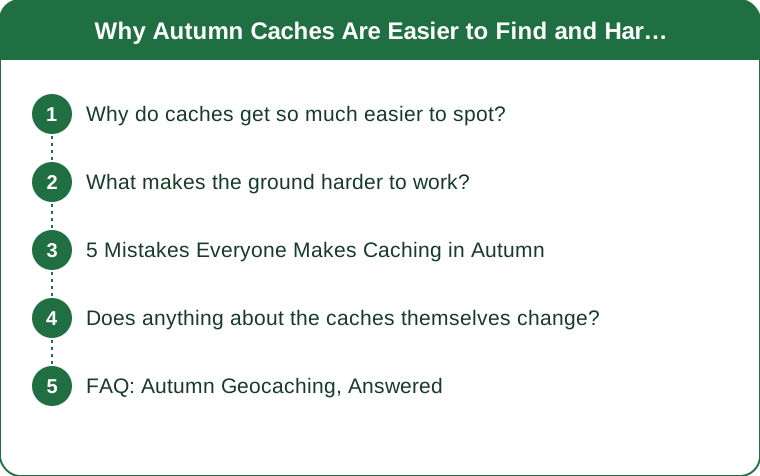
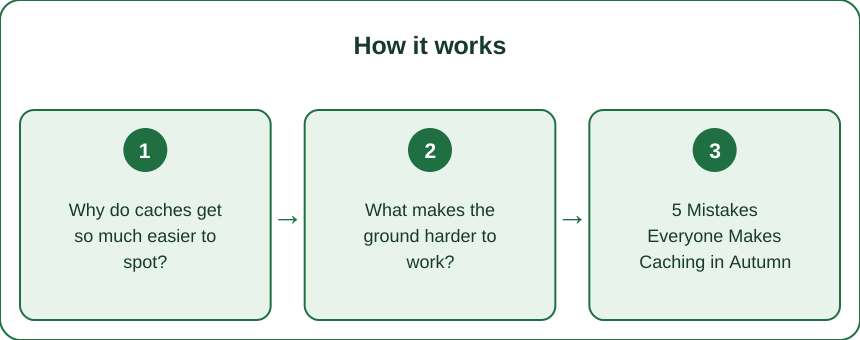
Why do caches get so much easier to spot?
Because almost every summer hide relies on foliage doing the concealment.
A cache tucked into the base of a shrub, wedged in a fork, or slid under a bramble is effectively invisible from June to September. Leaf fall removes the screening, and what remains is a container in plain view.
Sight lines transform. Woodland that offered five metres of visibility now offers thirty. You can stand at the coordinates and scan the whole area from one spot rather than working a spiral.
Ivy and bramble die back at ground level, which is where a large proportion of hides live. What needed hands-and-knees searching becomes a glance.
GPS accuracy actually improves under bare canopy. Dense summer foliage attenuates and scatters satellite signals, commonly degrading accuracy to eight or ten metres under heavy leaf cover. Bare branches interfere far less, and readings under a leafless canopy are often within three to five metres — a much smaller search circle.
The combined effect is significant. Long-standing did-not-find caches get logged in autumn at a noticeably higher rate, and it is worth deliberately revisiting your own failures now rather than waiting.
What makes the ground harder to work?
Leaf litter, and it works against you in three separate ways.
It hides the cache. The same fallen leaves that opened your sight lines are now sitting five centimetres deep over every ground-level hide. A cache at the base of a tree can be completely buried by a single windy night, and the log will fill with did-not-finds from people looking at exactly the right spot.
It hides the ground. Roots, holes, loose stones and old fence wire all disappear under leaves. Ankle injuries in woodland peak in autumn for exactly this reason — the visual information you normally use for foot placement is gone, and you are walking on a surface you cannot read.
It gets slippery fast. Wet leaves on a slope, on tree roots, or on a wooden boardwalk are genuinely treacherous — comparable to ice on a smooth surface. A path you have run down all summer becomes something to descend deliberately.
Add rising mud, and a route that took forty minutes in August can take an hour now. Plan for 25 to 30 percent longer on any woodland route from here on.

5 Mistakes Everyone Makes Caching in Autumn
1. Planning the route on summer timings. You will be slower. Build the extra time in before you set out, not by rushing at the end.
2. Forgetting how fast the light goes. In early September you lose roughly two to three minutes of daylight per day, and it accelerates. A trip planned three weeks ago on a sunset time you remember is a trip that finishes in the dark. Check today’s sunset, not last month’s.
3. Not carrying a torch on an afternoon trip. The single most common autumn mistake. A head torch weighs almost nothing and turns a stressful return into a normal one. Carry one from September onwards, always.
4. Digging through leaf litter aggressively. You will scatter the leaves that were camouflaging the hide, and you may damage the container or the surrounding habitat. Sweep gently with a hand or a stick, and put the litter back afterwards so the next cacher gets a fair search.
5. Wearing summer footwear. Trail shoes with worn tread on wet leaves and mud are the reason most autumn caching trips end early. Tread depth matters far more now than it did.
Does anything about the caches themselves change?
Yes, and it affects both finding and maintaining them.
Containers move. Wind, heavy rain and animals shift ground-level caches more in autumn than at any other time. A container that is two metres from where it should be will read as a did-not-find. Widen your search radius in autumn before concluding it has gone.
Water gets in. Seals that were fine in summer fail under sustained rain, and a soaked logbook is the most common autumn maintenance issue. If you own caches, this is the month to check them — carry spare logs and small ziplock bags on your own trips and swap out anything sodden.
Condensation is a separate problem. Even a well-sealed container will collect internal moisture as temperatures swing between warm afternoons and cold nights. A small silica sachet inside solves it.
Muggle traffic drops. Fewer people in the woods means easier retrieval on caches that are awkward to reach unobserved. This is genuinely one of the better times of year for urban-fringe and park caches for that reason alone.
Some caches get seasonally archived or become inaccessible. Waterlogged low ground, closed permissive paths and shooting seasons all take routes out of play. Read recent logs rather than relying on the cache page — a log from August tells you very little about October.
FAQ: Autumn Geocaching, Answered
Is it worth revisiting my old did-not-find caches now?
Yes — this is the single best reason to cache in autumn. Hides that depended on foliage become straightforward, and GPS accuracy under bare canopy is meaningfully better. Work through your DNF list in October and November.
How do I search leaf litter without wrecking the hide?
Sweep gently with an open hand or a stick rather than scraping, work in from the edges of the likely area, and restore the litter to roughly how you found it before you leave. If you find a cache buried, consider mentioning it in your log so the owner knows.
What should I add to my bag for autumn?
A head torch, a spare pair of socks, a small dry bag for your phone, spare logbooks and ziplocks, and gloves. Grippier footwear is the most valuable single change. This is general outdoor safety guidance — always tell someone your route if you are heading somewhere remote.
TL;DR:
- Leaf fall opens sight lines and improves GPS accuracy — old did-not-finds become findable.
- The same leaves bury ground-level caches and hide trip hazards.
- Budget 25 to 30 percent more time, check today’s sunset, and carry a head torch from now on.
- Check recent logs, widen your search radius, and expect wet logbooks.
Autumn is the best finding season of the year if you plan the return trip properly. Work your DNF list first.
Keep Reading
This article is for general informational and styling purposes only. Fit, sizing, and product availability may vary.