Why Autumn Is the Best and Worst Time to Find Caches
Quick Answer: Autumn improves visibility in the tree canopy and destroys it at ground level. Elevated and tree-based hides get substantially easier as leaves thin, while ground-level containers get buried under leaf litter and become genuinely hard to find. Adjust by prioritising elevated hides in autumn and saving ground hides for after the first hard rains flatten the litter.
The find rate does not drop in autumn — it redistributes, and knowing which way is the whole advantage.


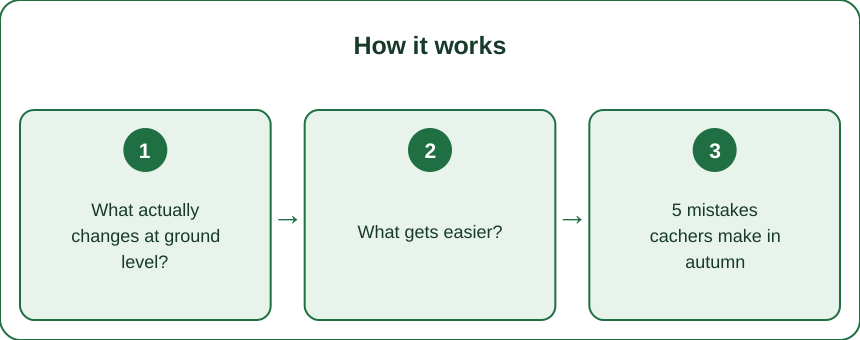
What actually changes at ground level?
Leaf litter accumulates faster than most people expect. In deciduous woodland, ground litter can reach several centimetres within two weeks of the main leaf drop. A container sitting under a log is now under a log and a blanket.
Litter also hides the ground clues. Most ground-level finds come from spotting the disturbance around a hide — a slightly displaced stone, a gap that looks deliberate. Leaves erase all of it uniformly.
Muggle traffic drops, which helps. Fewer casual walkers means less need for discretion and more freedom to search properly.
And the litter itself is unstable. Wind redistributes leaves constantly through October, so the same cache can be findable one day and buried the next. A DNF in autumn genuinely carries less information than a DNF in June.
The practical rule: if a cache has multiple recent autumn DNFs and a long history of finds, the cache is almost certainly still there and simply covered.
What gets easier?
Anything above head height. Tree hides, magnetic containers on structures, and anything using canopy cover become dramatically more visible as leaves thin. Some hides that were genuinely difficult in July are near-trivial in October.
Sightlines improve across the whole search area. In summer woodland you can see maybe fifteen metres; in November, sometimes eighty. Reading the terrain — spotting the one obviously placed rock pile — becomes far easier.
GPS accuracy improves noticeably. Canopy is the main cause of multipath error in woodland, and a bare canopy can improve accuracy from ten or twelve metres down to four or five. This alone changes the difficulty of a whole class of caches.
Trails become visible. Faint paths that were hidden under summer growth reappear, and a worn approach route is one of the most reliable indicators of a cache location there is.
Temperature helps too. Searching thoroughly is much more pleasant at 14C than at 28C, and thoroughness is most of the skill.

5 mistakes cachers make in autumn
1. Logging a DNF too quickly. Ground hides in leaf litter need a genuinely different search — clearing rather than looking. Two minutes of visual scanning is not a search in October.
2. Not checking the previous logs for the season. A cache with finds every week in summer and nothing since September is telling you it is a buried ground hide, not that it is missing.
3. Ignoring the wind direction. Leaves accumulate on the leeward side of obstacles. If a hide is at the base of a tree, the litter is deepest on the downwind side, and that is where to clear first.
4. Searching after rain without expecting the change. Wet leaves mat down and compress, which makes containers easier to feel underfoot but harder to see. The search technique should switch from looking to probing.
5. Putting the cache back at the same depth. Re-hiding a container under the leaves you cleared means the next finder faces a harder search than the owner intended. Restore the original concealment, not the seasonal one — this is the mistake that quietly makes autumn caching harder for everyone.
How should you plan an autumn caching day?
Front-load elevated and urban hides. These are at their easiest right now and the daylight is limited.
Save the ground hides for the walk back, when you have time to search properly and are not worried about covering distance.
Bring a stick. Genuinely — a walking pole or a stick for clearing litter turns a fifteen-minute ground search into a three-minute one.
Start earlier than you think. Sunset moves nearly an hour earlier across September, and a caching plan built in August will run out of light.
Carry a light regardless. A head torch turns the last hour into usable searching time, and it is the difference between finishing a series and abandoning it.
Check for ticks afterwards. Autumn is a second seasonal peak for tick activity in many regions, and leaf litter is exactly where they are.
And log honestly about conditions. An autumn log noting deep leaf cover is genuinely useful to the next finder and to the owner, and it is the sort of thing that keeps a series maintained.
TL;DR:
- Thinning canopy makes elevated hides much easier and improves GPS accuracy substantially.
- Leaf litter buries ground hides and erases the disturbance clues most finds depend on.
- Multiple autumn DNFs on a long-established cache usually mean covered, not missing.
- Clear the leeward side of obstacles first — that is where litter accumulates.
- Bring a stick, start earlier, carry a light, and check for ticks.
Autumn does not make caching harder. It swaps which half is hard, and the people who adjust have their best months of the year.
Keep Reading
This article is for general informational and styling purposes only. Fit, sizing, and product availability may vary.