Night Caching: What Changes When You Geocache After Dark
Quick Answer: Night caches typically rely on reflective markers that catch flashlight beams rather than visual landmarks used in daytime searches, which means the search technique itself changes (sweeping a light methodically rather than scanning visually), and reliable, hands-free lighting plus letting someone know your specific location in advance matter considerably more than for a typical daytime cache.
Night caching isn’t just daytime geocaching with worse visibility — it’s a distinct search method built around a completely different way of finding the cache.

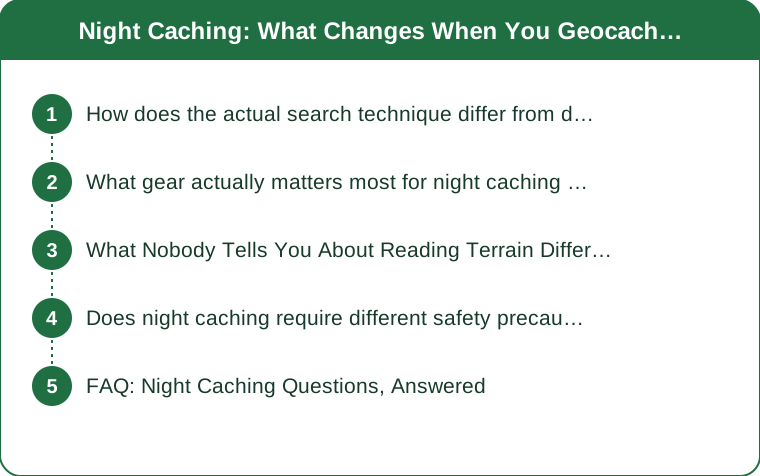
How does the actual search technique differ from daytime caching?
Night caches are frequently marked with small reflective tacks or markers placed along a trail leading to the final cache, meant to be spotted by shining a flashlight directly at eye level and slowly sweeping the beam across the area — this systematic sweeping technique, rather than the more visual scanning used in daytime searches, is specific to how night caches are typically designed to be found.
What gear actually matters most for night caching specifically?
A reliable, bright flashlight (a headlamp is often preferred since it keeps both hands free for navigating terrain and logs) matters more here than for daytime caching, along with backup lighting in case the primary source fails — being without light mid-search in unfamiliar terrain after dark is a meaningfully different problem than the same issue during the day.

What Nobody Tells You About Reading Terrain Differently in the Dark
Terrain that’s completely manageable in daylight (uneven ground, low branches, small drop-offs) becomes considerably harder to judge safely with only flashlight illumination — night caching generally calls for choosing lower-difficulty terrain ratings than you’d typically attempt during the day, since the terrain challenge itself is compounded by reduced visibility.
Does night caching require different safety precautions than daytime solo caching?
Yes, meaningfully more — sharing your specific planned location and expected return time with someone becomes more important given reduced visibility and typically fewer other people around after dark, and choosing well-established, well-reviewed night caches (checking recent logs for any reported access issues) is worth the extra step before heading out.
FAQ: Night Caching Questions, Answered
Are night caches specifically labeled as such on geocaching platforms?
Yes — most platforms allow caches to be tagged with a night cache attribute, and cache descriptions for these typically include specific notes about the reflective marker system or other night-specific finding method used.
Is night caching a good activity to try solo as a beginner?
It’s generally better to try a first night cache with an experienced partner or group if possible, given the added navigation and terrain challenges — going solo is more reasonable once you’re comfortable with daytime caching and have some sense of what to expect.
Do night caches tend to be more or less difficult to find than similarly rated daytime caches?
The official difficulty rating accounts for the night-specific search method, but many geocachers still find night caches subjectively more challenging than the same rating would suggest during the day, simply due to reduced visibility and the different technique required.
TL;DR:
- Night caches typically use reflective markers found by systematically sweeping a flashlight
- A headlamp with backup lighting matters more here than for typical daytime caching
- Terrain that’s easy in daylight becomes meaningfully harder to navigate safely after dark
- Sharing your specific plan and expected return time is more important than for daytime solo caching
Night caching is a genuinely different skill from daytime geocaching, not just a harder version of the same search — treating it that way sets up a much better first experience.
Keep Reading
This article is for general informational and styling purposes only. Fit, sizing, and product availability may vary.