Geocaching Tips for Finding Your First Caches (The Real-World Treasure Hunt)
Quick Answer: To find your first geocaches, start with caches rated difficulty 1–1.5 and size “regular” or “large,” read the hint and the last three logs before you search, and remember that phone GPS is typically accurate to about 3–5 meters — so expect to search a circle roughly 10 meters across, not to stand on the spot. Look for anything that seems man-made or out of place: a rock that doesn’t match, a stack of sticks too neat to be natural, a magnetic surface on a sign post.
There are millions of small containers hidden in public places all over the world, and you have walked past dozens of them. That’s the appeal — the ordinary lamppost outside the supermarket has a secret, and about eight million people are in on it.
Your first attempt will probably still fail, though. Here’s why, and how to fix it.

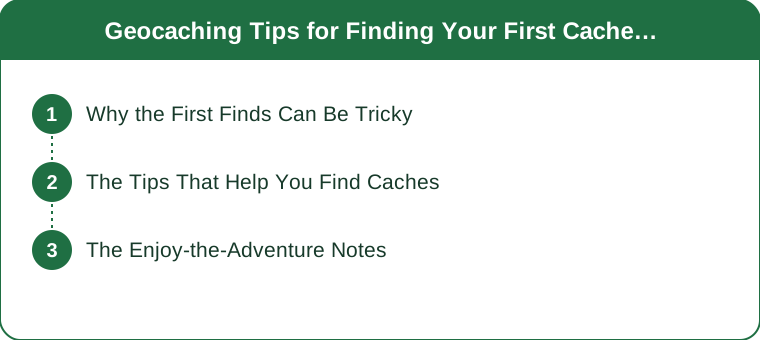
Why your first finds are harder than expected
GPS gets you close, not exact. A phone GPS is typically accurate to around 3–5 meters in open sky, and considerably worse under tree cover or between buildings. The cache owner’s coordinates carry their own error too. Practically, “you have arrived” means the cache is somewhere in a circle about 10 meters across — which contains a surprising number of rocks.
Caches are camouflaged on purpose. Fake rocks. Hollow bolts. Containers painted to match bark. A film canister wedged in a wall crack. Cache hiders take genuine pride in this, and difficulty ratings exist for a reason.
Sizes range enormously. A “nano” is the size of your fingertip and often magnetic. A “large” might be an ammo can. If you’re scanning for a lunchbox and the listing says micro, you’ll walk past it twenty times.
Searching is a learned skill. After about ten finds you start recognizing hiding patterns instinctively. Before that, everything looks like nothing.
The tips that actually find caches
1. Filter for easy ones first. In the app, filter to difficulty 1–2, terrain 1–2, and size “small,” “regular,” or “large.” Skip nanos and anything rated D3+ until you have ten finds behind you. This single change turns a frustrating first outing into a successful one.
2. Read the hint before you search, not after. Almost every listing has an encrypted hint. Beginners save it as a matter of pride, then spend 25 minutes not finding a cache. Read it.
3. Read the last three logs. This is the most underused tool in geocaching. Recent logs tell you whether the cache is still there, whether people are finding it easily, and often contain accidental spoilers like “wow, higher than I expected.”
4. Watch the D/T ratings. Difficulty (D) is how hard the cache is to find; Terrain (T) is how hard it is to reach. A D1/T4 is easy to spot but requires a climb. A D4/T1 is at your feet and you still won’t see it.
5. Think like the hider. Where would you put it? Cache hiders like anything that provides cover and stays put: the base of a fence post, a tree hollow, under a loose rock, behind a sign, inside a wall gap, in an ivy tangle.
6. Look for what doesn’t belong. A pile of sticks arranged too neatly. A rock sitting on top of leaf litter instead of under it. A bolt with no purpose. Human hiding leaves patterns, and once you see them you can’t unsee them.
7. Bring a magnet or use your fingers. Enormous numbers of urban caches are magnetic and stuck to the underside of metal — signs, benches, railings, guard rails. Run your hand along the underside of metal things. You will feel like a criminal. This is normal.
8. Circle out from ground zero. Stand at the coordinates, then search in widening rings. Don’t fixate on the exact GPS pin — walk 10 meters away and come back, which resets your phone’s position and often improves accuracy.
9. Be discreet. Non-geocachers are called “muggles,” and part of the game is not revealing caches to them. If someone’s watching, wander off and come back. Looking like you’re just checking your phone is the standard cover.

What nobody tells you about geocaching
Your first DNF is a rite of passage. DNF = Did Not Find. Everyone has them, including people with 10,000 finds. Log it honestly — DNFs help cache owners know when something’s gone missing.
Bring your own pen. Every cache has a logbook and you sign it. Roughly half the time the pen inside is dried out, missing, or a soggy pencil stub. A small pen in your bag solves the single most common first-timer disappointment.
The swag is not the point. Larger caches contain trinkets — a keychain, a toy soldier, a foreign coin. The etiquette is trade equal or trade up. Nobody’s finding treasure; the fun is in the finding.
It walks you further than you’d plan to walk. A three-cache afternoon routinely turns into five kilometers, and you barely notice because you’re hunting rather than exercising. It’s genuinely one of the better accidental fitness activities.
It takes you to strange, good places. Cache hiders put them where something is worth seeing — a viewpoint, an odd piece of local history, a park nobody visits. After a year you’ll know your own area much better than your neighbors do.
Trackables are a whole extra hobby. Some items have codes and are traveling to a goal, sometimes across continents. If you pick one up, move it along within a couple of weeks — sitting on someone’s travel bug for eight months is the closest thing geocaching has to a cardinal sin.
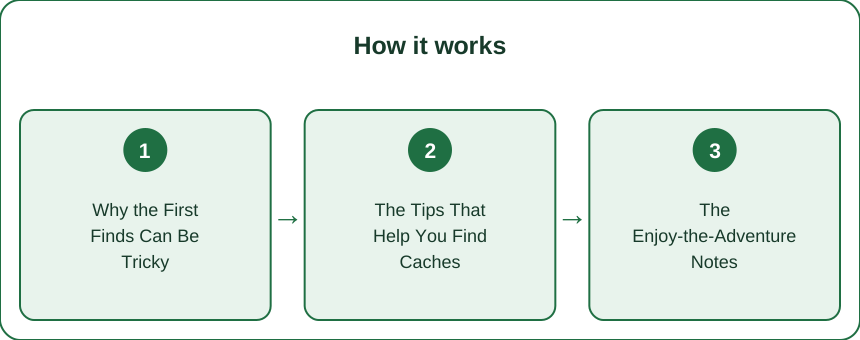
Getting started properly
Get the app and pick three nearby caches. All beginner-friendly, ideally in the same park so you’re not driving between them.
Pack light: phone, a pen, tweezers (for pulling tight logs out of small containers), a small flashlight, and hand sanitizer. That covers 95% of finds.
Sign, replace exactly, and log it. Put the cache back exactly as you found it, in the same spot, same camouflage. A cache replaced badly gets muggled and disappears.
Log online. It records your find, thanks the owner, and helps the next person.
Bring people. Kids are unreasonably good at this — they’re closer to the ground and they haven’t learned where adults expect things to be. Geocaching turns a boring walk into a mission, which is the single best trick for getting a reluctant seven-year-old to walk 4 km.
Hide your own after 20–30 finds. Once you understand what makes a cache good, maintaining one for the community is the natural next step.
A few safety and etiquette notes
Don’t trespass — if reaching a cache means crossing private property or climbing a fence, it’s the wrong cache. Watch terrain ratings honestly, especially T4–5 caches which can involve climbing or water. Be alert to ticks in long grass and check yourself afterward. Never dig for a cache; nothing is ever buried. And don’t search suspicious-looking containers near sensitive infrastructure — if a spot feels wrong, walk away and log a note.
FAQ
How do you find geocaches for the first time?
Download a geocaching app, filter to difficulty 1–2 and terrain 1–2 with size “regular” or larger, read the hint and the last three logs, then navigate to the coordinates and search a 10-meter circle. Look for anything man-made or out of place, and check the undersides of metal objects for magnetic containers.
Why can’t I find geocaches even when I’m at the coordinates?
Phone GPS accuracy is typically 3–5 meters, worse under trees, so the cache is somewhere in a circle around you rather than at your feet. Read the hint, read recent logs, and search in widening circles. Also check the size — if it’s a micro or nano, you’re hunting something the size of a thumb.
Is geocaching still popular?
Yes — there are millions of active caches worldwide and a large community still hiding, finding, and maintaining them. Most towns have dozens within a few kilometers, and urban areas often have hundreds.
TL;DR:
- Start with difficulty 1–2, terrain 1–2, size regular or larger. Skip nanos entirely at first.
- Read the hint and the last three logs before you search.
- GPS accuracy means searching a ~10m circle, not standing on the spot.
- Look for the out-of-place: too-neat sticks, mismatched rocks, pointless bolts.
- Check under metal surfaces — a huge share of urban caches are magnetic.
- Bring your own pen. The one in the cache is usually dead.
- Replace the cache exactly as found, log it online, and be discreet around muggles.
Keep Reading
This article is for general informational and styling purposes only. Fit, sizing, and product availability may vary.