Geocaching in Tick and Chigger Season: What Actually Works
Quick Answer: Ticks and chiggers concentrate in exactly the habitat caches are hidden in - tall grass, leaf litter, and the edges between mown and unmown ground. The protection that reliably works is permethrin-treated clothing plus a repellent on exposed skin, trousers tucked into socks, and a full body check within two hours of finishing. Chiggers additionally respond to showering promptly, since they have not attached the way ticks do. Nothing you wear replaces the check.
The cache is four metres off the trail, in the long grass.
That four metres is where the entire risk lives.
This is general information, not medical advice.

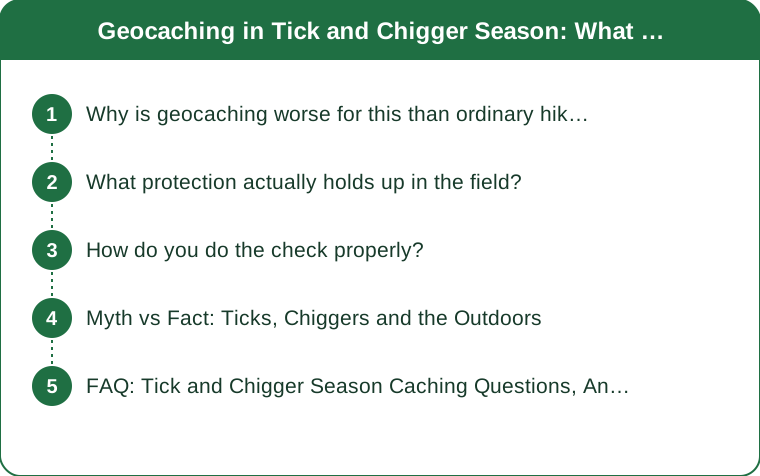
Why is geocaching worse for this than ordinary hiking?
Because the activity requires you to leave the path, and the path is the safe part.
Ticks concentrate at habitat edges - the transition between mown grass and tall grass, between trail and undergrowth, between field and woodland. This is called the ecotone, and it is where tick density is highest. It is also precisely where caches get hidden, because edges have the features a hider needs: stumps, fence posts, tree bases, rock piles.
Chiggers are similar but sit lower. They live in leaf litter, tall grass and damp shaded ground, and they climb onto anything that brushes past. Reaching under a log, kneeling to check a rock crevice, or pushing through waist-high growth are all direct contact with their habitat.
The specific behaviours that raise exposure:
- Stopping still in vegetation while you search, rather than walking through it
- Reaching into leaf litter, hollows and undergrowth with bare hands and forearms
- Kneeling and sitting on the ground to reach low hides
- Repeating this at every cache, several times per outing
A hiker on a trail passes through in seconds. A cacher stands in it for five minutes at a time, several times a day. That is the whole difference.
Timing compounds it. Late summer is peak season for chiggers and for nymph-stage ticks, which are the size of a poppy seed and account for a large share of transmitted disease precisely because they are so hard to see.
And the undergrowth is at its maximum right now, which pushes you closer to the vegetation to reach the same hide that was easy in April.
What protection actually holds up in the field?
A two-layer system: treated clothing, and repellent on the skin the clothing leaves out.
Permethrin on clothing is the single most effective measure available. It is applied to fabric, not skin, and it kills or disables ticks on contact rather than merely repelling them. A treatment survives multiple washes - typically around six - and treated socks and trouser legs are where it earns its value, since that is where ticks make contact first.
Treat these specifically: socks, trouser legs from the knee down, boot uppers, and the cuffs of any long sleeves. Let it dry fully before wearing - it is only meant to be handled dry.
Skin repellent covers what fabric does not. DEET at 20 to 30% is well established and works on both ticks and chiggers. Picaridin at 20% is comparably effective, does not damage synthetic fabric, and smells far less - for anyone in technical outdoor kit, this is the practical choice.
Clothing strategy does real work on its own:
- Trousers tucked into socks. It looks ridiculous and it removes the main entry route
- Light colours, purely so you can see a poppy-seed nymph before it reaches skin
- Tightly woven fabric over loose weaves, which chiggers walk straight through
- Boots over trail shoes when you know the undergrowth is deep
Gloves are the underrated item. A thin pair of gardening or work gloves for reaching into hollows and under logs removes hand and forearm exposure entirely and costs almost nothing.
What does not work well enough to rely on: wristbands, ultrasonic devices, and most botanical-only repellents. Oil of lemon eucalyptus has some evidence behind it but needs far more frequent reapplication than the alternatives.

How do you do the check properly?
Within two hours, in a systematic order, and with a mirror for the places you cannot see.
Timing is the whole point. Transmission risk for most tick-borne illness rises substantially the longer a tick stays attached, and many require many hours of attachment. A tick found and removed the same afternoon is a very different proposition from one found on Tuesday.
Check in this order, because it maps to where they actually end up:
- Behind and around the knees, then up the backs of the legs
- Waistband, groin and buttocks - the single most common attachment area
- Navel and under the breasts
- Armpits and inner arms
- Back of the neck and along the hairline
- Scalp, by feel, working systematically
- Behind the ears and in the ear folds
Use a mirror or a phone camera for the back, and check the scalp with fingertips rather than eyes. Nymphs are roughly poppy-seed sized, which is why a visual scan alone misses them.
Removal, if you find one attached: fine-tipped tweezers, grip as close to the skin as possible, pull straight up with steady even pressure. Do not twist, do not burn it, do not apply petroleum jelly or anything else - those methods are folklore and some of them make things worse. Clean the area afterwards.
Note the date and keep an eye on the site. A spreading rash or flu-like symptoms in the following weeks is the thing to take to a doctor, and knowing the date of the bite is genuinely useful clinical information.
Two habits that make the whole system work: put the day’s clothes straight into a hot tumble dryer for 10 minutes - dry heat kills ticks that laundering alone may not - and shower promptly, which physically removes anything unattached and is the main defence against chiggers specifically.
Myth vs Fact: Ticks, Chiggers and the Outdoors
Myth: Chiggers burrow into your skin. Fact: They do not. They attach at the surface, usually where clothing is tight, feed on broken-down skin cells, and drop off within a few days. The intense itching is a reaction to their saliva, and the bump is your skin, not the mite. Which is why scrubbing in a shower within a few hours works so well.
Myth: You will feel a tick bite. Fact: Tick saliva contains a mild anaesthetic, so most bites are entirely painless. This is exactly why a systematic check matters more than waiting to notice something.
Myth: Ticks drop out of trees. Fact: They climb up from ground level vegetation in a behaviour called questing, waiting on grass tips and low undergrowth with front legs extended. Which is why trouser legs and socks are the front line, not hats.
Myth: Cold weather means the season is over. Fact: Adult ticks stay active well into autumn and can be active any time the ground is not frozen. Late season caching in leaf litter is not a risk-free window.
Myth: Nail polish or a hot match makes a tick back out. Fact: Both are actively bad advice. They can cause the tick to regurgitate into the bite. Fine tweezers, steady straight pull, and nothing else.
Myth: Repellent on your skin protects your legs through your trousers. Fact: It protects skin, not fabric. Ticks walk across untreated cloth without difficulty. Permethrin-treated clothing is what covers that gap, and it is why the two-layer system exists.
FAQ: Tick and Chigger Season Caching Questions, Answered
How soon do I need to check after caching?
Within two hours is a sensible target, and same-day is the real threshold. Risk of transmission for most tick-borne illness climbs with attachment time, so a tick found the same afternoon is far less concerning than one found days later.
Does permethrin go on skin?
No - it is a clothing treatment only. Spray it on socks, trouser legs, boot uppers and sleeve cuffs, let it dry completely, then wear. Use DEET or picaridin on exposed skin instead.
Why do chigger bites appear around my waistband and sock line?
Chiggers climb until they meet resistance, and tight clothing is where they stop and attach. Waistbands, sock tops and bra lines are the classic pattern, which is also a useful clue for identifying what bit you.
Does showering actually help?
A great deal for chiggers, since they sit on the skin surface unattached for hours before feeding and a soapy shower removes them. Less so for an already-attached tick, though it helps find them and washes off unattached ones.
What should I watch for after a tick bite?
A spreading or bullseye rash, fever, aches or unusual fatigue in the following days and weeks. Note the date of the bite - it is genuinely useful information for a doctor. Seek medical advice if any of those appear.
Are gloves really worth carrying?
Yes, and they are the cheapest improvement available. Most hand and forearm exposure comes from reaching into hollows, under logs and into leaf litter, which a thin pair of work gloves eliminates entirely.
TL;DR:
- Caches sit at habitat edges and in leaf litter, which is exactly where ticks and chiggers concentrate
- Two-layer protection: permethrin on socks and trouser legs, DEET or picaridin on exposed skin
- Tuck trousers into socks, wear light colours, carry thin gloves for reaching into hides
- Full body check within two hours, in order, with a mirror - nymphs are poppy-seed sized
- Remove attached ticks with fine tweezers, straight up, no twisting or burning
- Shower promptly and tumble dry clothes hot for 10 minutes
- Chiggers sit on the surface and respond well to prompt washing; they do not burrow
The gear helps. The check is what actually protects you.
Keep Reading
This article is for general informational and styling purposes only. Fit, sizing, and product availability may vary.