Why Geocaching Racks Up More Actual Mileage Than It Feels Like You're Walking
Quick Answer: Geocaching racks up more mileage than it feels like because backtracking doesn’t register as distance the way forward progress does — you cover the same 50 meters six times while searching, and your brain files it as “looking,” not “walking.” Track it with a GPS app that logs your actual path, not straight-line distance between cache points, and check the total after the session rather than estimating during it.
You spent the afternoon poking around tree stumps and reading coordinates off a phone. Felt like a puzzle, not a workout.
Then you check your step count and it says nine kilometers, and you genuinely cannot account for where they came from.

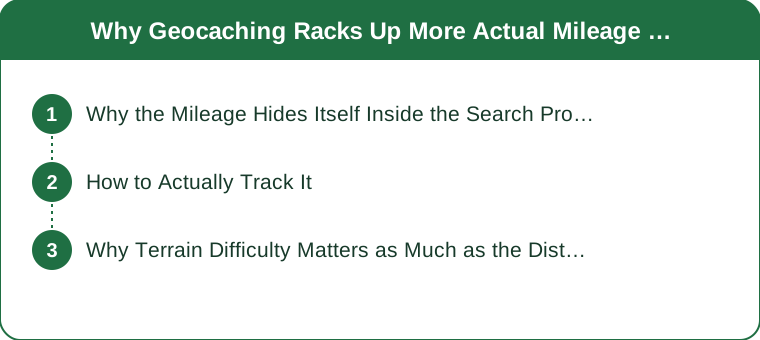
Why Does Geocaching Feel Shorter Than It Is?
Three things conspire, and the first is the big one.
Backtracking doesn’t feel like distance. When you’re 20 meters from a well-hidden cache, you circle. You check the obvious stump, cross to the fence line, come back, widen the arc, come back again. Twenty minutes of that is easily 400–600 meters of real walking — and none of it feels like progress, so none of it registers. On a hike, every step moves you toward somewhere. Here, every step moves you around the same spot.
Your attention is on the puzzle, not the path. Distance perception depends heavily on paying attention to it. A hiker is watching the trail, the mileage, the summit. A geocacher is reading a hint, decoding a cipher, and scanning for something that looks slightly too deliberate. The cognitive load sits entirely elsewhere, and your internal odometer just doesn’t run.
Off-trail ground costs more per meter. Pushing through brush, stepping over roots, scrambling up a bank, going around a fallen tree — all of it is more physically demanding than the same distance on a maintained trail, and all of it is slower, which further disconnects time-elapsed from distance-covered.
The net effect: a typical multi-cache afternoon can quietly deliver more walking than a deliberate 5K, in a form that never once felt like exercise. Which is, arguably, the best kind of exercise there is.

How Do You Actually Track Geocaching Mileage?
Log the path, not the points. This is the whole trick, and it’s where most people go wrong.
Cache-to-cache straight-line distance is a huge underestimate — it counts the direct line between two coordinates and ignores every meter of searching, circling, and backtracking in between. On a hard cache, the search itself can be more distance than the walk to get there.
What to do:
- Use a GPS app or watch that records your actual track — a continuous breadcrumb, not waypoint distances. Any standard fitness tracking app does this; so does a dedicated GPS handheld.
- Start it at the trailhead and leave it running. Including the searching. Especially the searching.
- Check the total after the session, not during. Estimating distance while you’re actively hunting is unreliable in exactly the way this whole article describes — and checking it mid-hunt interrupts the thing that makes geocaching fun.
- Log the terrain rating alongside the distance (more on why below).
- Watch for GPS drift under tree cover. Dense canopy can add phantom distance by scattering your recorded position. If a number looks implausibly high for a small search area, that’s usually why.
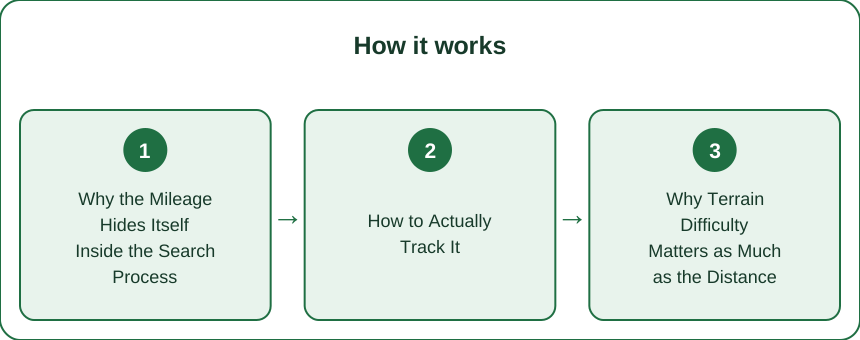
Why Terrain Rating Matters as Much as Distance
Geocaches carry a terrain rating from 1 to 5, and it’s the missing variable in any mileage number.
A short search on steep, dense, or overgrown ground routinely produces more real exertion than a longer search on flat open trail. Two kilometers of scrambling up a wooded slope is a genuinely harder session than five kilometers on a paved park path — and if you only log distance, the harder one looks like the easier one.
Logging both numbers gives you a far more honest picture:
- Terrain 1–2: flat, accessible, often paved. Distance is a fair proxy for effort.
- Terrain 3: off-trail, uneven, some elevation. Effort runs meaningfully above what the distance suggests.
- Terrain 4–5: steep, dense, sometimes requiring special equipment. Distance badly understates the workout.
If you’re tracking this for fitness reasons, “4.2 km, terrain 3.5” tells you something real. “4.2 km” on its own doesn’t.
FAQ
How many miles do you walk geocaching?
It varies enormously with cache density and terrain, but an unhurried afternoon covering several caches commonly lands somewhere in the 3–6 mile range — usually well above what participants estimate. The only way to know your own number is to log an actual tracked session.
Is geocaching good exercise?
It’s genuinely good low-intensity exercise, and its real strength is adherence: people walk further and stay out longer when the activity has a goal that isn’t the walking. Terrain 3+ caches add real elevation and scrambling on top of the distance.
Does a fitness tracker count geocaching accurately?
Step counts are reasonably accurate. GPS distance can drift under heavy tree cover, sometimes inflating totals in dense woods. If you want a reliable number, a continuous GPS track from a dedicated app or watch beats straight-line cache-to-cache math by a wide margin.
TL;DR
- Backtracking is invisible distance — you cover the same ground repeatedly and it never feels like progress.
- Attention is on the puzzle, so your sense of distance doesn’t run.
- Off-trail ground costs more per meter than a maintained trail.
- Track the actual walked path, not straight-line distance between caches.
- Check the total after the session, not during.
- Log the terrain rating too — a short terrain-4 hunt can beat a long terrain-1 one for real exertion.
- Expect the number to surprise you. It usually does.
Keep Reading
This article is for general informational and styling purposes only. Fit, sizing, and product availability may vary.