Why Your GPS Says 'You're Here' But the Cache Clearly Isn't (GPS Drift Explained)
Quick Answer: Consumer GPS accuracy is typically 10-30 feet even in good conditions, and can drift further under tree canopy or near tall structures — treat the GPS coordinate as the center of a search circle, not an exact pin, and search in an expanding spiral rather than standing still.
Your GPS confidently says you’re standing on the cache. You’re not, and it’s not lying — it’s just working within limits most geocachers never think about.
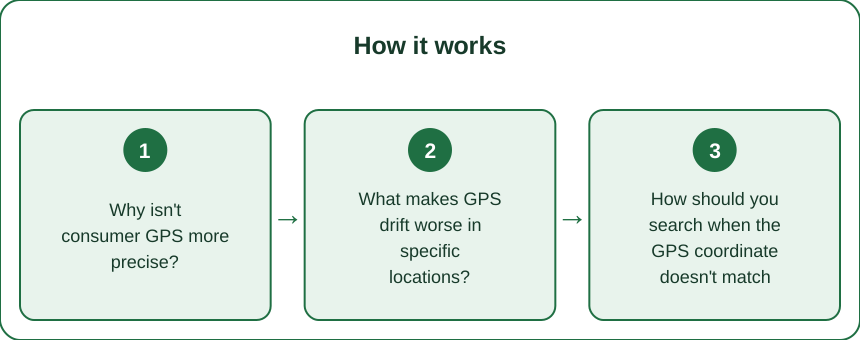
Why isn’t consumer GPS more precise?
Consumer-grade GPS receivers (phones, handheld units) are accurate to roughly 10-30 feet under open sky, not the few-feet precision people assume. This comes from inherent limitations in how civilian GPS signals are processed, combined with atmospheric interference and satellite geometry at any given moment.
Military and survey-grade GPS achieves much tighter accuracy using additional correction signals that consumer devices don’t access — the gap between ‘GPS says here’ and ‘actually here’ is a known, expected feature of the technology, not a malfunction.
What makes GPS drift worse in specific locations?
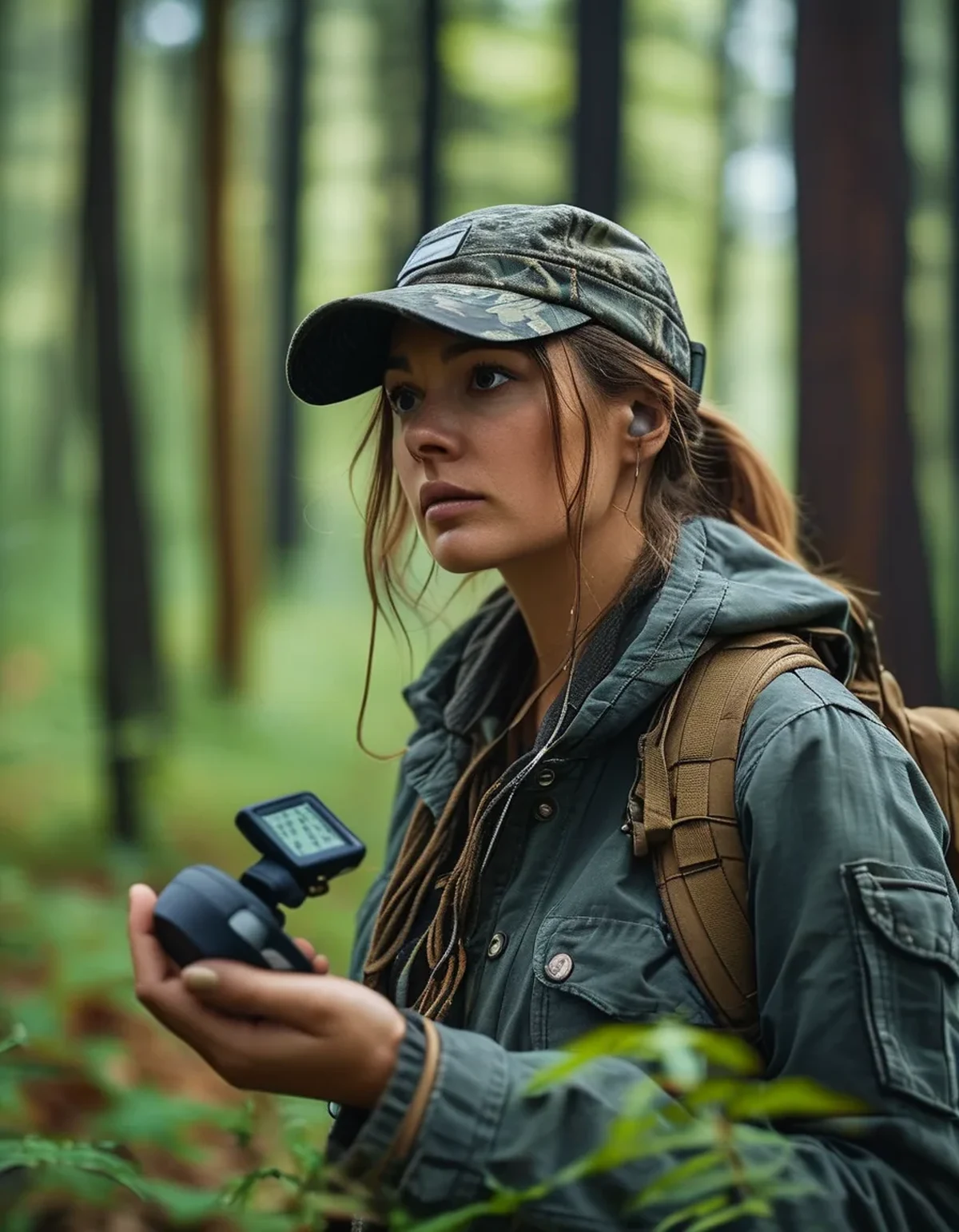
Tree canopy, canyon walls, and tall buildings all degrade accuracy further by blocking or bouncing satellite signals (a phenomenon called multipath interference). Dense forest — extremely common terrain for geocaching — can push error out to 30-50 feet or more.
Weather and atmospheric conditions add smaller additional variance day to day, which is part of why the same cache can feel ‘easier’ or ‘harder’ to find on different visits even with no change to the hide itself.

How should you search when the GPS coordinate doesn’t match reality?
Treat the coordinate as the center of a circle, not a pin. Standard practice: stand at the coordinate, then search in an expanding spiral outward, checking likely hiding spots (base of trees, under rocks, in stumps) within roughly a 30-foot radius before assuming something else is wrong.
Cache placers also experience the same GPS drift when hiding the cache and logging coordinates — meaning the listed coordinate itself may already carry that same 10-30 foot error, compounding with your own device’s error on the search end.
What Nobody Tells You About ‘GPS Accuracy’ Readings
Most GPS apps display an accuracy estimate (like ‘±15 ft’) — this number itself is an estimate, not a guarantee, and tends to be optimistic. Real-world error is often somewhat larger than the displayed accuracy figure, especially under partial canopy where the device might report decent accuracy while still being off by 20+ feet.
Experienced geocachers learn to treat the displayed accuracy number as a rough confidence indicator rather than a precise error bound, and rely more on hint text and terrain logic than chasing the GPS arrow to zero.
FAQ: Geocaching GPS Accuracy Questions, Answered
Can I improve my phone’s GPS accuracy for geocaching?
Stepping into open sky (away from canopy or buildings) for a minute before searching often helps the device get a better satellite lock; dedicated handheld GPS units also generally outperform phones in dense terrain.
Why do two different geocachers get different GPS readings at the same spot?
Different devices, different satellite locks at that moment, and normal GPS variance — small discrepancies between devices at the same physical location are expected, not a sign one device is broken.
Should I trust the GPS or the hint more when they conflict?
The hint, generally — cache placers write hints specifically because they know GPS coordinates alone are often insufficient, especially in tricky terrain.
TL;DR:
- Consumer GPS is accurate to roughly 10-30 feet, not pinpoint precision
- Tree canopy and tall structures make drift worse, sometimes 30-50+ feet
- Search the coordinate as a circle’s center, spiraling outward, not a fixed pin
- Trust hints over chasing the GPS arrow to exactly zero when they conflict
Keep Reading
This article is for general informational and styling purposes only. Fit, sizing, and product availability may vary.