5 Geocaching Beginner Mistakes That Waste an Entire Afternoon
Quick Answer: The most common time-wasting beginner mistakes are relying purely on GPS coordinates without reading the cache’s difficulty/terrain rating and hint first, searching in an area too large because of normal GPS accuracy drift, giving up too early on caches rated as genuinely tricky, ignoring recent log entries that reveal a cache is temporarily missing, and not budgeting enough total time per cache attempt.
A frustrating afternoon of geocaching usually traces back to one of these specific, avoidable habits rather than bad luck.

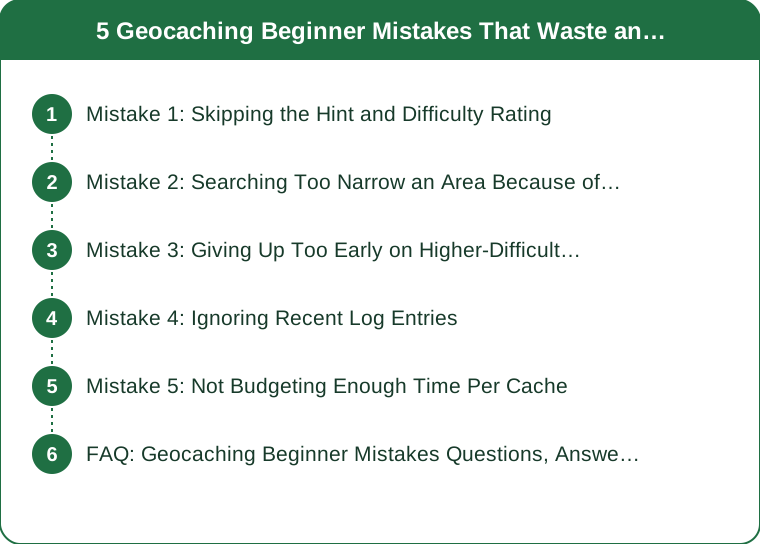
Mistake 1: Skipping the Hint and Difficulty Rating
Every geocache listing includes a difficulty and terrain rating along with an optional hint, and skipping these in favor of just following GPS coordinates blindly is one of the most common ways beginners waste time on caches that were never going to be found through coordinates alone, since some caches are deliberately designed with tricky, non-obvious hiding spots that the hint specifically addresses.
Mistake 2: Searching Too Narrow an Area Because of GPS Drift
GPS accuracy under tree cover, near buildings, or in canyon-like areas commonly drifts 10-30 feet from the true location, and beginners searching only in a tight radius directly around where the GPS points can completely miss a cache that’s actually a short distance away — widening the search radius once the immediate spot comes up empty resolves this.
Mistake 3: Giving Up Too Early on Higher-Difficulty Caches
Caches rated with higher difficulty are intentionally challenging and sometimes require looking well beyond the first obvious hiding spots (under rocks, in tree hollows, cleverly disguised containers) — giving up after a quick, surface-level search on a cache explicitly rated as difficult wastes the setup effort already invested without giving the search a fair attempt.

Mistake 4: Ignoring Recent Log Entries
Recent log entries from other geocachers often reveal important, current information — a cache reported missing, damaged, or temporarily inaccessible — and skipping this step before heading out can mean an entirely avoidable wasted trip to a cache that isn’t actually findable at that time.
Mistake 5: Not Budgeting Enough Time Per Cache
Underestimating how long a single cache search can reasonably take, especially for higher-difficulty caches, leads to rushing multiple caches in one outing and getting frustrated with all of them rather than fully committing to fewer caches — planning for a realistic 15-30 minutes per cache, more for higher difficulty, produces a much less frustrating outing overall.
FAQ: Geocaching Beginner Mistakes Questions, Answered
Is it okay to ask for help or hints from other geocachers if stuck?
Yes — many geocaching communities are quite willing to give additional hints beyond the listing’s built-in hint, especially for a cache with a track record of stumping multiple people, and asking isn’t considered bad form.
Should beginners start with low-difficulty caches specifically?
Yes, generally — starting with caches rated low on both difficulty and terrain builds comfort with the basic process before attempting more challenging, deliberately tricky hides.
Does the type of GPS device or app matter for avoiding these mistakes?
Somewhat — a dedicated GPS device is sometimes more accurate than a phone app in certain conditions (dense tree cover, canyons), but for most beginner-level caching, a good geocaching phone app combined with reading the hint and recent logs matters more than the specific device used.
TL;DR:
- Reading the hint and difficulty rating first avoids attempting caches that need specific knowledge to find
- GPS drift means widening the search radius beyond the exact pinned location often helps
- Higher-difficulty caches deserve a genuinely thorough search before giving up
- Checking recent logs first avoids wasted trips to missing or inaccessible caches
Most frustrating geocaching afternoons come down to one of these five specific, avoidable habits rather than the hobby itself being unreasonably hard.
Keep Reading
This article is for general informational and styling purposes only. Fit, sizing, and product availability may vary.